
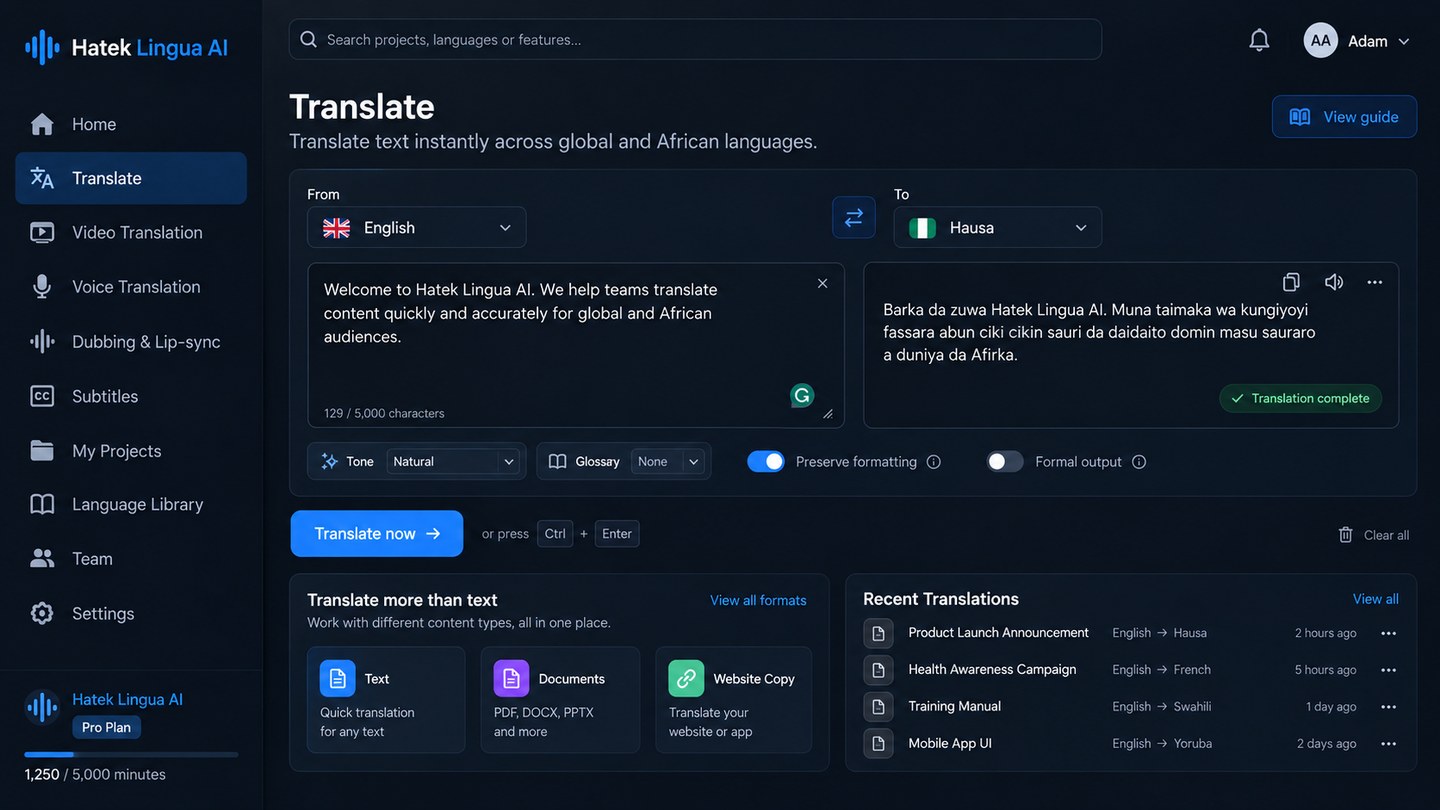
Source and target language controls sit alongside the translated result.
The translation workspace shows how language selection, terminology controls and output review fit into the broader localisation experience.
Hatek Lingua AI brings language support into the full localisation workflow, from speech and translation to generated voice, subtitles and audiovisual output. Availability can vary by language and workflow.
Hatek Lingua AI connects speech recognition, translation, generated voice and audiovisual synchronisation within the same language workflow.
Language handling covers speech recognition, translation, speech generation, pronunciation, timing, code-switching, accents, dialects and native-language review.
Speech recognition and timing across different speakers and recording conditions.
Meaning, terminology and context across source and target languages.
Natural target-language speech for names, terminology and local expressions.
Speech timing that fits the pace and structure of the source video.
Native-speaker review for accuracy, pronunciation and naturalness.
Users select source and target languages, manage tone, terminology and formatting, and review translated output inside the same workspace.
The translation workspace shows how language selection, terminology controls and output review fit into the broader localisation experience.
The Hatek Lingua AI language programme spans 100+ languages, including 50+ African languages. Available workflows include translation, voice, dubbing and subtitles.
The language directory spans West, East, Central, Southern and North Africa.
Language availability can vary by feature and account. The directory below highlights languages represented across the Hatek Lingua AI language programme.

Use the filters to explore languages by region.
Hatek Lingua AI evaluates language quality across speech, translation, voice, timing and audiovisual output.
Language data, terminology, speech patterns and regional requirements inform the workflow.
Speech, translation and generated voice are processed as connected product capabilities.
Native-language review supports translation, pronunciation, timing and audiovisual quality.
Language availability is managed across translation, voice, dubbing and subtitle workflows.